DayPrivate / Daily planner app
Free, paid, printable, or paper
Choosing a daily planner app you are still using in March.
Search this phrase and you get app store listings and roundups that rank five to eleven apps apiece, each written by a company with its own app at the top of the list. Paper barely shows up, even though for plenty of people it is the right answer. So here is the comparison, paper included, written by someone who builds the digital kind and has an obvious stake in it. Weigh it accordingly. DayPrivate is a daily planner app for Mac, iPad and iPhone that keeps the plan and the clock in the same outline, in a file on your own disk.
The short answer on daily planner apps
A daily planner app earns its keep when your day changes shape after it starts. It can move a block you missed, read the calendar the meetings already live in, and tell you at the end of the week where the hours actually went. Paper does none of those three. If your work is steady and you mainly need somewhere to think, a paper planner or a free printable is the better buy, and this page says so in full further down rather than pretending otherwise.
DayPrivate is the daily planner app built here. It runs on Mac, iPad and iPhone, keeps your plans, your time blocks and your tracked time as bullets in one outline stored as a database file on your own disk, and costs eight dollars a month or sixty nine dollars a year for one plan with everything in it. DayPrivate is not free, no free tier is planned, and the build is not publicly released yet, so if you need a daily planner app installed this week, the honest answer is Apple Reminders next to a calendar, a printed template, or the free tier of an app like Structured or TickTick. DayPrivate does not run on a Windows PC or an Android phone at all, and TickTick's free plan, whose download page lists Windows, Mac, Linux, iPhone, iPad and Android, covers both.
Before you buy anything
One phrase, four different products. Work out which daily planner you are shopping for.
A daily planner app search returns four different products, not four versions of the same one. A bound book, a page you print, a list with dates on it and a planner that owns your clock solve different problems, and DayPrivate is only the last of the four. Picking the wrong category is usually the real reason the last one lasted three weeks.
Already ruled out paper? Then the comparison you want is between the digital ones, and DayPrivate's day planner app page covers that, including the parts DayPrivate does not do.
The question under the search
Free daily planner apps, and why DayPrivate is not one.
Most people typing daily planner app want to know whether they have to pay for one. You do not. Apple Reminders and Google Calendar cost nothing on the devices you already own and will plan a day between them, one holding the tasks and the other holding the hours. A printed template is free forever, at the cost of you being the sync, the archive and the search function. And a number of the paid daily planner apps that rank for this phrase run a free tier and charge for the parts you hit later, usually calendar sync, longer history, or automatic scheduling, which is worth checking before you commit a year of days to one.
DayPrivate is not one of the free ones. DayPrivate is eight dollars a month or sixty nine dollars a year, one plan with everything in it, and there is no free tier planned. The reason is what DayPrivate does not do: there is no account and no company server holding your outline, so there is no user data to sell and nothing to fund a free tier with. If free is the requirement, take one of the free options above and come back if it stops holding your day.
The popularity question
The most popular daily planner app, and why popularity is a weak reason to pick one.
The most popular daily planner app depends entirely on which pile you are reading, and DayPrivate is in none of them. Here is what is actually sitting at the top of this search, and what popular is measuring when you see it.
On the October 2026 results for daily planner app, two of the pages are Google Play listings for small planner apps, one is a YouTube video and one is an r/productivity thread asking the same question you are. The rest are roundups, and each one is published by a company that sells its own planner or productivity app: NotePlan reviews ten apps in about six thousand words, Planyway ranks ten with itself first, Saner.AI says it tested twenty and picked five, and AFFiNE lists eleven free ones. The names that keep recurring across them are Todoist, TickTick, Google Calendar, Notion, Apple Reminders, Any.do, Sunsama, Structured and Routine.
Structured is the one that shows up as a daily planner by name. Its Google Play listing says Structured is free to use with optional Pro features, and its App Store listing covers iPhone, iPad and Mac. If you already use it and it has stopped fitting, DayPrivate's page on the apps people move to from Structured lists what each one costs.
So popular daily planner apps are popular for installs and reviews, and installs follow store placement, a free tier and an advertising budget. None of those three tell you whether an app can hold a Tuesday that falls apart at 14:00. Category is the filter that actually narrows this, which is why the four kinds above are worth two minutes before any ranked list of ten. DayPrivate has no ratings to quote, because the build is not publicly released, and inventing a star count to sit next to everyone else's was not on the table.
Where the AI daily planner apps fit
Two daily planner apps sell automatic scheduling as the headline rather than as a feature, and Planyway's roundup for this search ranks Motion as best for automatic scheduling. Motion says it prioritizes and timeblocks your tasks on your calendar and optimizes your schedule dozens of times a day. Morgen says its AI Planner alerts you to conflicts, can reprioritize your plan in one click, reminds you of previously scheduled incomplete tasks, and highlights tasks that are unscheduled and at risk of being late. Motion's download page lists apps for Windows, macOS 11 or later, iOS and Android, plus the web, and Morgen's lists Windows 10 or later, macOS 12 or later and Linux, with iOS and Android apps alongside, so if your day happens on a PC both of those are live options and DayPrivate is not.
DayPrivate takes the other side of that argument on purpose. Auto-block lays out a day you have already chosen, around the Apple Calendar events you already keep, and names what did not fit instead of quietly reshuffling your afternoon. DayPrivate's optional AI features are writing help on the Mac, and they refuse any endpoint that is not your own computer, in code rather than as a setting you could flip. If you want the app to decide what today is about, take one of the two above. If what you actually want is a guided morning ritual without the AI, DayPrivate's page on replacing Sunsama's daily planning ritual covers that branch.
Comparing the digital planners against each other feature by feature is a different job, and DayPrivate's day planner app page carries that category map. If the shortlist you are really weighing is Mac task apps, the task manager for Mac page splits those. Platforms and free tiers named here come from each vendor's own site, checked while this page was written. If Akiflow is the planner you are weighing against Motion and Morgen, DayPrivate's page on what Akiflow and its alternatives cost lists each price from the vendor's own pricing page.
PC, Android, iPhone, iPad, Mac
Which daily planner app runs on your device, and where DayPrivate does not.
A daily planner app only helps on the device your day happens on, and DayPrivate covers three of the five devices people search for. The table lists, for each device, apps whose own download page or store listing says they run there, and whether DayPrivate does. Platforms were checked on each vendor's site on 3 October 2026.
| Device | Daily planner apps the vendor says run there | DayPrivate |
|---|---|---|
| Windows PC or laptop | TickTick (free plan), Google Calendar in any browser, and the AI schedulers Motion and Morgen | No. No Windows build and no browser version. |
| Android phone | TickTick (free plan), Structured (free, optional Pro), Tiimo, Motion, Morgen | No. No Android build. |
| iPhone | Apple Reminders with Apple Calendar (built in), Structured, TickTick, Tiimo | Yes, once released. |
| iPad | Apple Reminders with Apple Calendar (built in), Structured, TickTick, Tiimo | Yes, once released, with Apple Calendar read on iPad. |
| Mac | Apple Reminders with Apple Calendar (built in), TickTick, Structured, Motion, Morgen | Yes, once released, plus the Mac only parts: Apple Calendar mirroring, the menu bar timer, quick capture and the local AI features. |
What is the best daily planner app for PC?
For most people on a Windows PC, the best daily planner app is TickTick's free plan or Google Calendar in the browser, because both run on Windows at no cost and TickTick's free plan syncs to an Android phone or an iPhone. If you want the app to lay out the day for you, Motion and Morgen both ship Windows apps. DayPrivate is not an option on a PC: it is a native Mac, iPad and iPhone app with no Windows build and no browser version.
The same answer covers a free daily planner app for a laptop. TickTick's download page lists Windows, macOS and Linux, and Google Calendar needs nothing but a browser, so neither cares which laptop you own. On a Mac, Apple Reminders and Apple Calendar are already installed and free.
Sources: Motion's download page (iOS, Android, macOS 11 or later, Windows, web), Morgen's download page (Windows 10 or later, macOS 12 or later, Linux, plus iOS and Android), TickTick's download and plans pages, Structured's Google Play and App Store listings, and Tiimo's homepage.
Students
A daily study planner is a different shape, and DayPrivate fits half of it.
A daily study planner app has to carry three things a work planner usually does not. A timetable that repeats every week for a whole term. Deadlines weeks out that all land in the same fortnight. And revision, which works better spread over several days than crammed into one. Miss any of the three and what you have is a to do list with a lecture in it.
DayPrivate holds the first two and not the third. A weekly lecture can repeat as a task or sit in the Apple Calendar DayPrivate reads, and a deadline carries an alert and shows up in DayPrivate's Upcoming view across the next fourteen days. There is no term view, and nothing schedules spaced revision for you. What DayPrivate adds is the part most study planners skip: an estimate on every piece of work and a timer that records what it actually took, so after a fortnight you know a problem set is a ninety minute job rather than the forty minutes you keep budgeting for it.
The honest recommendation for most students is a free one. DayPrivate is eight dollars a month or sixty nine dollars a year with no free tier, it runs on Mac, iPad and iPhone only, and it is not publicly released, so a student on a Windows laptop or on no budget should take Apple Reminders beside a calendar, a printed timetable, or a free tier from the apps above. Blocking revision against the hours you genuinely have is the one move worth copying whichever you pick, and DayPrivate's time blocking app page walks through that step on its own.
What is the best assignment tracker app?
An assignment tracker app is the deadline half of a daily study planner: every essay and problem set with its due date, sorted by what lands first. For most students the best assignment tracker app is a free one already on the device, Apple Reminders with a due date on each piece of work, or TickTick, whose free plan includes task reminders and sync across Windows, Mac, iPhone, iPad and Android. DayPrivate can hold deadlines with an alert and a fourteen day Upcoming view, but it has no term view and it is a paid Apple only app that is not released yet, so it is not the assignment tracker to pick this semester.
The first real decision
Daily, weekly, or undated. Pick the daily planner layout before you pick the brand.
Paper planners are sold in daily, weekly and undated layouts and leave the choice to you, and every daily planner app including DayPrivate inherits the same question. It is the decision that actually matters, because layout settles how much of your week you can see at once and how much guilt an empty page can produce.
In DayPrivate you are not picking one. The same outline draws a day grid and a week grid in half hour slots, and you work in whichever one the week calls for.
The honest half of the comparison
What paper is genuinely better at, and where it stops.
Both sides of the paper against daily planner app comparison are worth saying out loud, including the side that costs DayPrivate a sale. Paper is not a worse planner. It is a different one, and it fails in a specific place.
What paper does better
And no app has fixed any of these.
- Thinking. Handwriting is slower than typing, and slow is the point when the job is deciding what the day is for.
- Never interrupting. A notebook has no notifications, no update prompts, and no other apps one gesture away.
- Privacy, outright. A book in your bag has no sync, no vendor, and nothing to breach. Software can get close to this and cannot match it.
- Starting. You open it and write. No account, no import, no setup, no workspace to design first.
What paper cannot do
The five places a paper day comes apart.
- Tell you the truth about time. It records what you intended. Comparing that with what happened means running a stopwatch and doing the arithmetic yourself, every day.
- Move. A block written at 09:00 and missed at 11:00 has to be crossed out and rewritten by hand, so most people stop rewriting and the page goes stale by lunch.
- See your calendar. The meetings that eat the day live somewhere else, so your plan and your actual constraints never sit on the same surface.
- Be searched. Last March is in a book on a shelf if you kept it, and gone if you did not.
- Say anything. It is a surface, not a participant. It will never point out that the block just ended with the important thing untouched.
The part the product pages skip
How do I make my daily planner? Four moves, in paper or in DayPrivate.
The roundups for daily planner app run to thousands of words about which planner to buy, and almost none about the routine that makes any of them work. The routine is the same in a notebook and in DayPrivate.
To make a daily planner, decide the two or three outcomes today owes you before you list anything, estimate each action and place it against the hours left after your meetings, work one thing at a time while recording when it started and stopped, and close the day by choosing on purpose what moves to tomorrow. That works in a paper notebook, and DayPrivate builds each of the four moves into the app.
Decide before you list
Name what today owes you first: two or three outcomes with an actual result attached. Then write the actions under them. A list written before that decision is a pile sorted by whatever you happened to remember first.
Put it against real hours
Estimate each piece and lay it on the day you actually have, with the meetings already in it. Nearly every overloaded day is visible at this step, on paper as much as on a screen, and only if you do it.
Work one thing, and keep the receipt
The point is a record of what happened, not only what was planned. On paper that is a start and an end time in the margin. In DayPrivate it is one timer at a time on any bullet, plan row, or block, and it survives a crash.
Close the day and carry on purpose
Choosing what moves to tomorrow is the whole discipline. Anything that rolls forward three days without being looked at is either not a MUST or not real. DayPrivate offers yesterday's unfinished work one day at a time, so carrying stays a decision.
That first move has a name if you want the long version. Here is how DayPrivate builds the rapid planning method in.
Two searches, one phrase
Planning a daily routine is a different job from planning a day.
Daily routine and daily plan get typed into the same box, and a daily planner app, DayPrivate included, usually only does one of them well. A routine repeats: the same wake time, the same block of deep work, the same gym slot, five days a week. What that wants is tasks that come back without being retyped and a streak you can see, and the streak is a habit tracker's job. A day is a one off: today has three meetings that were not on Monday, and what that wants is somewhere to put the real work around them without pretending the meetings are not there.
DayPrivate is built for the second job. DayPrivate repeats a task on a fixed schedule or after completion and can start tomorrow from a saved outcome template, so the fixed parts of a routine can live inside a DayPrivate day. What DayPrivate does not have is a habit streak, and if a visible streak is the whole reason you are searching, a habit tracker will serve you better. Everything else in DayPrivate treats the day as an outline placed against real hours, with yesterday's unfinished work offered forward one day at a time rather than piling up silently.
Where a daily planner app for ADHD fits
The daily planner app built for that search is Tiimo, not DayPrivate. Tiimo describes itself as a visual AI planner built by and for neurodivergent people, and says it makes planning easier for ADHD'ers with visual timers, AI checklists, and flexible scheduling. Tiimo runs on iOS, iPadOS, watchOS, Android and the web. DayPrivate was not designed around ADHD and does not claim to be: its timer is one running clock on a bullet, plan row or block, and its day is a grid in half hour slots rather than a visual timeline. If a visual day is what keeps you on track, try Tiimo or Structured first.
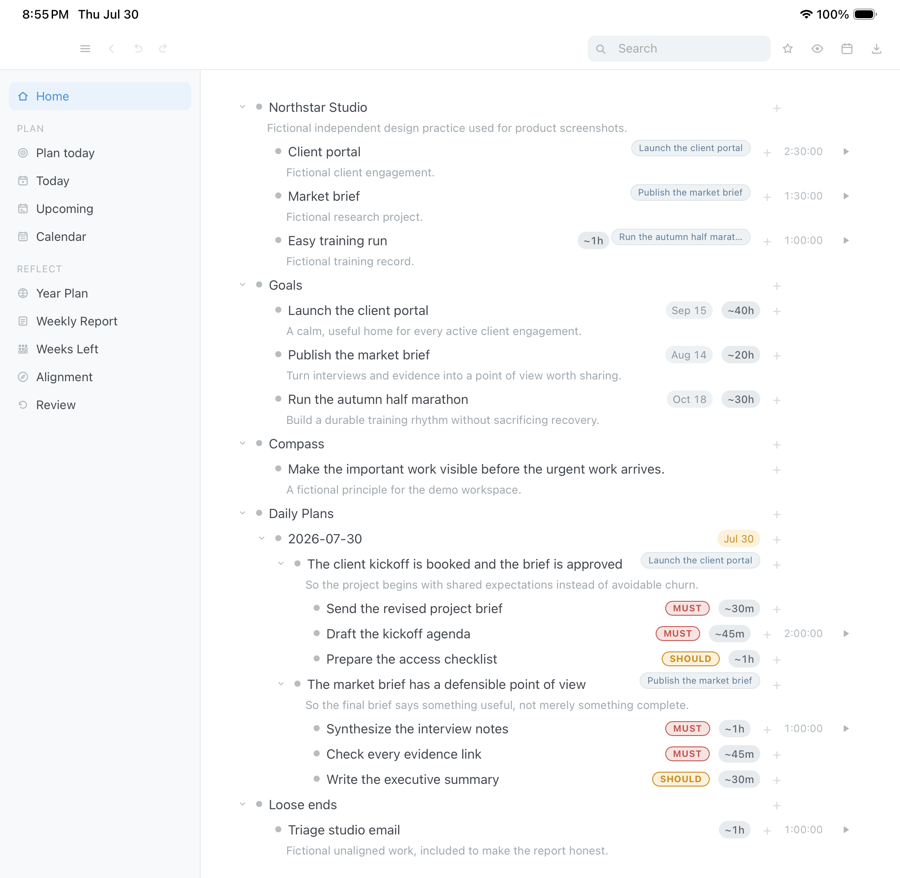
DayPrivate planning a single day by outcome, with the MUST and SHOULD actions and their time estimates made explicit before anything is placed on the clock.
Drag the capture sideways to see the rest. Open full size
Placing a one off day against the hours it actually has is time blocking, and DayPrivate's time blocking software page walks through that step on its own, including the six ways it usually goes wrong.
Where this one fits
A daily planner that answers back.
DayPrivate is an outliner first. Your plans, your blocks and your tracked time are ordinary bullets in one document you can zoom, mirror, search and export. The planner sits on top of that rather than beside it.
You name two or three outcomes for the day, each with the result you want by tonight and your reason for it, then mark the actions underneath MUST or SHOULD. Auto-block lays them on the grid in one press, around the calendar you already keep and inside your day start and day end, and it names what did not fit instead of quietly dropping it.
Then the part a notebook cannot do. When a block ends with a MUST still open, one card appears while you can still act on it, offering re-block today, re-block tomorrow, or leave it, and dismissing it counts as a decision, so it never asks twice about the same ending. The next morning a carry tray offers yesterday's unfinished work forward. On Sunday the weekly review is derived from your tracked time, your blocks, your carries and your calendar, and it never asks you to rate the week.
Next morning, yesterday read back to you
DayPrivate runs on Mac, iPad and iPhone. There is no browser version, no Windows or Android build, and no watch app. A few surfaces are macOS only, including mirroring your blocks back into Apple Calendar, the menu bar timer, quick capture, and the optional local AI features. The full table is on DayPrivate's day planner device comparison.
The one thing paper always wins
The closest a digital daily planner gets to a notebook in your bag.
A paper planner leaks nothing because it connects to nothing. A daily planner app cannot claim that outright, so here is exactly what DayPrivate does, which is the accounting you should demand of any planner before you hand it a year of your days.
Not collected
Bullets, plans, notes, blocks and tracked time are written to a database file on your own device, and Settings shows you its exact path. There is no account and no company database holding any of it.
Nothing measured
No analytics in the app, no crash pings, no usage counters. Not anonymised, not aggregated, none. This marketing site is a separate thing and does use ordinary web analytics.
Your own iCloud Drive
Devices exchange encrypted change sets through iCloud Drive under a passphrase that stays in the device keychain. Nobody else can read those files, including this app's author.
The only traffic that leaves a DayPrivate device is traffic you asked for, and the whole accounting, including the calendars and the local AI features, is in the privacy section of the overview.
Straight answers
When a paper daily planner, or a different app, beats DayPrivate.
- You want a planner in your hands this week. Buy the paper one. DayPrivate is in daily use and under active development, but it is not publicly released and it is not on the App Store yet.
- You want a free printable. Then a template gallery is the right answer and this is not. DayPrivate is a paid app and there is no free tier planned.
- Your day happens on Windows or Android. This is Mac, iPad and iPhone only, with no browser version planned and no watch app.
- You want the app to decide the day. Auto-block lays out a day you have already chosen. It will not rank your work for you or work out what today is about from a priority score.
- You need your team in it. No shared boards, no assignees, no comments, and none of that is planned. It is built for one person's day.
- The handwriting is the point. Nothing digital replicates it. Plenty of people plan on paper and track the time in software, and that is a perfectly good answer to this search.
Price
DayPrivate is eight dollars a month, or sixty nine a year.
That is one DayPrivate plan with everything in it, on every Mac, iPad and iPhone you own, for one person. No team tier to be upsold to and no feature held back for a higher one. If the plan lapses, the last version you paid for keeps working and your outline and exports stay yours, which is the digital equivalent of the book still being on your shelf. See what the plan includes.
One message, then nothing
Hear when the build is ready.
One email when DayPrivate is ready to install, and nothing else. No drip sequence and no newsletter.
Your address is used for that one message and nothing else.
Questions
Daily planner app questions, answered about DayPrivate and about the alternatives.
Is there a free daily planner app?
Yes, several. Apple Reminders and Google Calendar cost nothing on the devices you already own and will plan a day between them. A printed template is free forever, at the cost of you being the sync, the archive and the search function. A number of the paid daily planner apps that rank for this phrase also run a free tier and charge for the parts you hit later, usually calendar sync, longer history, or automatic scheduling. DayPrivate is not one of the free ones.
Is DayPrivate a free daily planner app?
No. DayPrivate is eight dollars a month or sixty nine dollars a year, one plan with everything in it, and there is no free tier planned. The reason is what it does not do: there is no account and no company server holding your outline, so there is no user data to sell and nothing to fund a free tier with. If free is the requirement, take one of the free options and come back if it stops holding your day.
Which app is best for a daily routine?
That depends on whether your routine repeats. A repeating routine wants tasks that come back without being retyped and a streak you can see, which is a habit tracker's job. A day that looks different every morning wants somewhere to put the work around the meetings, which is a daily planner app's job. DayPrivate is built for the second one. DayPrivate repeats a task on a fixed schedule or after completion and can start tomorrow from a saved outcome template, but it has no habit streaks, so if a visible streak is what keeps your morning routine alive, a habit tracker will serve you better.
What is the best daily planner app for PC?
For most people on a Windows PC, the best daily planner app is TickTick's free plan or Google Calendar in the browser, because both run on Windows at no cost and TickTick's free plan syncs to an Android phone or an iPhone. If you want the app to lay out the day for you, Motion and Morgen both ship Windows apps. DayPrivate is not an option on a PC: it is a native Mac, iPad and iPhone app with no Windows build and no browser version.
How do I make my daily planner?
To make a daily planner, decide the two or three outcomes today owes you before you list anything, estimate each action and place it against the hours left after your meetings, work one thing at a time while recording when it started and stopped, and close the day by choosing on purpose what moves to tomorrow. That works in a paper notebook, and DayPrivate builds each of the four moves into the app.
What is the best assignment tracker app?
An assignment tracker app is the deadline half of a daily study planner: every essay and problem set with its due date, sorted by what lands first. For most students the best assignment tracker app is a free one already on the device, Apple Reminders with a due date on each piece of work, or TickTick, whose free plan includes task reminders and sync across Windows, Mac, iPhone, iPad and Android. DayPrivate can hold deadlines with an alert and a fourteen day Upcoming view, but it has no term view and it is a paid Apple only app that is not released yet, so it is not the assignment tracker to pick this semester.
What is the most popular daily planner app?
Popularity on this search is mostly measuring app store placement and who wrote the roundup. The roundups ranking for daily planner app are each published by a company that sells its own planner or productivity app, and the names they keep repeating are Todoist, TickTick, Google Calendar, Notion, Apple Reminders, Any.do, Sunsama, Structured and Routine. Structured is the one sold as a daily planner by name, free with optional Pro features. None of that tells you whether an app can hold your Tuesday, and DayPrivate is on none of those lists, because it is not released yet and has no ratings to quote.
What is the best daily study planner app?
For most students it is a free one. A daily study planner has to carry a timetable that repeats every week, deadlines that are weeks out, and revision spread across days, and Apple Reminders next to a calendar, or a printed timetable, covers the first two at no cost. DayPrivate repeats tasks and alerts on deadlines, but it has no term view and nothing that schedules spaced revision, and it is a paid Mac, iPad and iPhone app that is not released yet, so it is not the study pick. What DayPrivate adds is an estimate on every piece of work and a timer that records what it really took.
Is an AI daily planner app better than planning the day yourself?
It depends on whether your constraints are the kind you can type in. Motion and Morgen both sell automatic scheduling: Motion says it prioritizes and timeblocks your tasks on your calendar and optimizes your schedule dozens of times a day, and Morgen says its AI Planner alerts you to conflicts, can reprioritize your plan in one click, reminds you of previously scheduled incomplete tasks, and highlights tasks that are unscheduled and at risk of being late. That works when the deadlines and the durations are written down. DayPrivate takes the other side: auto-block lays out a day you have already chosen and names what did not fit, and DayPrivate's optional AI features are writing help on the Mac that refuse any endpoint which is not your own computer.
Is a paper daily planner or a daily planner app better?
It depends on the day you are trying to plan. If your work is fairly steady and you mainly need somewhere to think, paper is genuinely good, cheaper, and harder to abandon. If your day is chopped up by other people, changes shape after lunch, and you want to know afterwards where the hours actually went, paper stops keeping up, because it cannot move a block for you and it cannot see your calendar.
What is the difference between a daily planner and a to-do list?
A list records what you would like to do. A daily planner commits it to a time, which is what forces the decision about what will not happen today. That is the whole difference, and it is why planners feel harder than lists.
Should I pick a daily or a weekly layout?
Daily if your work is detailed and hour bound, weekly if it moves in multi day chunks and you need to see the shape of the week. In software the question mostly goes away: DayPrivate draws the same outline as a day grid and a week grid, and you can work in either.
Do I need a dated planner or an undated one?
That question only really exists on paper, where the dates are printed and a January start is a real constraint. It is why so many paper planners come in an undated version. A digital planner is undated by definition, so a gap in February costs you nothing except February.
Does a daily planner app work without an internet connection?
DayPrivate does. Everything in DayPrivate runs against a local database file on your device. There is no account and no server call in the normal running of the app, so a plane, a tunnel, or a bad hotel connection changes nothing.
Can I get my plans out again if I stop using the app?
Yes. Export the whole outline to OPML, plain text, CSV, or a self contained HTML report whenever you like, and Settings shows you the exact path of the database file on your own disk. If a plan lapses, the last version you paid for keeps working.
Can I plan around the calendar I already keep?
Yes. Apple Calendar is read on Mac, iPad, and iPhone, and those events show beside your blocks as context that never counts toward planned or tracked time. On the Mac your blocks are also mirrored back into a calendar you choose. Google Calendar is Mac only and read only.
Can I try DayPrivate today?
Not yet. The build is in daily use and under active development, but it is not publicly released and it is not on the App Store. If you need a daily planner in your hands this week, buy the paper one. The form above is how you hear when there is something to install, and the product overview walks through the whole app.